



-
 £8.50Select options This product has multiple variants. The options may be chosen on the product page
-
£6.00Select options This product has multiple variants. The options may be chosen on the product page
-
£54.00Select options This product has multiple variants. The options may be chosen on the product page
-
£12.50Select options This product has multiple variants. The options may be chosen on the product page


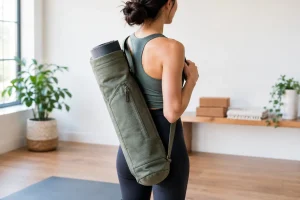
November 8, 2026A yoga mat can hold the quiet evidence of a long relationship with practice: the places where your hands meet the surface in Downward Dog, the familiar texture beneath your spine in rest, the folds it gathers after being carried to class in the rain.
Yoga mat bags are more than a way to get your mat from A to B. Chosen well, they protect a valued piece of equipment, your mat and bring a little more care to the rituals around your mat.
For a home practitioner, a bag may keep a mat clean, rolled and ready in the corner of a room. For a teacher moving between studios, it needs to carry far more, perhaps a blanket, strap, notes and water bottle alongside the mat. The right choice depends on the practice you lead and the life you lead around it.
Why yoga mat bags deserve consideration
Leaving a mat loose in the boot of a car, under a desk or on a busy studio floor exposes it to dust, damp and unnecessary wear. This matters particularly with natural materials, where moisture and poor storage can shorten the useful life of a much-loved mat. A bag creates a protective layer while also giving your mat a proper place to live, and underlines the precious ritual of yoga practice.
There is a practical benefit too. When a mat is awkward to transport, it becomes easier to miss the class. A comfortable shoulder strap and a bag that opens without a struggle supports ease and flow. Yoga teaches us to notice the small choices that shape our habits. Keeping your equipment together is one of them.
A beautiful bag can also feel like an extension of practice rather than another piece of sports kit. Thoughtful colour, textile and craft have a place here, especially when they are matched by responsible production. The goal is not to acquire more, but to choose an item that serves faithfully for years.
Choosing a yoga mat bag for your mat and routine
Start with the dimensions of your rolled mat, rather than assuming one size fits all. A standard lightweight mat takes up relatively little room, while a thicker mat for therapeutic work, restorative practice or extra joint support may need a wider bag. Measure the diameter of your rolled mat if possible, and remember that a new mat may soften and roll more compactly over time.
Length matters as much as width. A bag that is too short leaves the ends exposed, while one that is much too long can feel cumbersome. Full-length zipped styles offer the greatest coverage. They are particularly useful for cyclists, commuters and anyone who carries their mat on public transport. Sling-style carriers are lighter and quicker for short journeys, but they offer less protection from wet pavements and crowded changing rooms.
Consider what else genuinely travels with you. If you regularly carry a strap, eye pillow or small towel, a modest outer pocket can be useful. Teachers and retreat leaders may prefer a roomier design that accommodates a blanket or change of clothes. A larger bag sounds appealing, but excess space can make a packed bag swing against the body and place more strain on the shoulder. Choose capacity for your real routine, not an imagined one.
The strap should feel good on the body
A yoga mat bag ought to be comfortable before it is decorative. An adjustable strap allows you to alter the fit over a winter coat, a light summer layer or a cross-body position. Wider straps tend to distribute weight more comfortably, especially with a heavier mat and props inside.
Think about how you travel. A short handle may be enough for a walk from the car to the studio. If you walk to class, take the train or cycle, a secure, adjustable shoulder strap is usually worth prioritising. Small details such as reinforced stitching and secure fastenings become significant when a bag is used several times a week.
Fabric, lining and breathability
Natural cotton has a soft, grounded feel and can be a durable choice when well made. It is also easy to appreciate the character of a woven or printed fabric, particularly when the pattern has been created with care rather than applied as a passing trend. Heavier fabrics provide more structure and protection, though they may take longer to dry if caught in rain.
A breathable construction is helpful if you roll up your mat soon after a warm class. Even then, it is best to allow the mat to air before packing it away when you can. A bag is not a substitute for cleaning and drying your mat. It is a companion to those habits.
Synthetic, water-resistant fabrics can suit frequent outdoor practice or damp commutes, but it is worth checking their quality and intended lifespan. The most responsible choice is rarely determined by one material alone. Durability, repairability, responsible manufacture and how long you will use the item all deserve a place in the decision.
Ethical craft brings meaning to everyday equipment
Yoga invites ahimsa, or non-harm, into more than the shape we make with our bodies. It can inform how we buy, use and care for the objects that support our practice. That does not mean every purchase must be perfect. It means asking useful questions: who made this bag, is the work fairly valued, and is this something I will cherish rather than replace quickly?
Handcrafted yoga accessories often carry a level of attention that mass-produced alternatives do not. The stitching, fabric selection and finishing can give a bag both strength and personality. When craftsmanship supports skilled makers and women’s livelihoods, an everyday purchase can become part of a more considered chain of care.
At Yoga United, this principle informs the approach to yoga equipment: practical props should be made with devotion to function, material quality and the people involved in their creation. For studios and teachers buying several bags or props, choosing durable, ethically made pieces also communicates something clear to students about the values held in the teaching space.
Packing your bag without damaging your mat
A little care in packing prevents bent edges, trapped moisture and an overstuffed shape. Wipe the mat after practice according to its material requirements, then allow it to dry fully if it is damp. Roll it evenly from one end rather than forcing it into a tight, uneven bundle. A mat that sits naturally inside its bag will be easier to take out and use.
Keep sharp objects away from the mat. Keys, hair grips and loose pen tops have a habit of finding their way into bags and can mark delicate surfaces. If you carry cleaning spray, make sure the cap is secure and consider placing it in a separate pouch. A small towel, strap and eye pillow can sit alongside the rolled mat without difficulty, provided the bag has enough room.
For those travelling to a retreat or taking a yoga holiday, the bag can be an excellent day-to-day carrier once you arrive. However, a yoga mat bag is not always suitable as checked luggage on its own. Airline handling is hard on straps and zips, so place it within a larger case or use additional protection where needed. The most beautiful fabric deserves sensible care.
Caring for yoga mat bags between classes
Turn the bag inside out occasionally and shake out any dust or grit. If the fabric is washable, follow the care instructions closely, particularly for richly coloured printed textiles that may need a cool, gentle wash. Spot cleaning is often enough for small marks. Allow the bag to dry completely before returning the mat, as storing it damp can create stale odours.
Check the strap joins and zip every few months, especially if you use the bag daily. Addressing a loose stitch early is easier than waiting for a strap to fail on the way to class. If your bag has been part of your routine for years, a simple repair can be a quiet act of respect for the materials and labour within it.
The best bag is not necessarily the largest, brightest or most feature-heavy. It is the one that fits your mat, moves comfortably with your body and makes it more inviting to keep showing up. Let it hold the practical necessities, while you carry the more essential part of yoga with you: steady attention, wherever you practise. [...]
Read more...

October 20, 2026Most yoga students have their own yoga mat these days which takes the strain off a teacher from carrying heavy teacher’s bags full of kit.
A simple prop can feel like a quiet extension of your instruction: supportive, stable and ready when it is needed.
Props are not a sign that someone is less able. Used with sensitivity, they make the practice more accessible, more supported and more honest. They may support letting go or holding on depending what is required in the class whether its hatha, yin, restorative, chair or any kind of yoga for ‘real people’.
Now you don’t have to carry bags of mats, teachers can carry lighter loads that show students how much they care about their safety, and value of what you do. Light blocks and bricks, yoga straps and eye pillows can enhance the student experience so they can sit comfortably, reach the floor safely and rest deeply, they are freer to attend to their breath and experience. This guide to yoga teacher supplies is for teachers building a dependable kit with care, whether you teach a weekly community class, see private clients or are preparing a dedicated studio space.
Rather than carrying every possible prop, you can choose beautiful, durable equipment that serves your teaching style, your students’ bodies and the kind of practice you wish to offer.
What kind of props do teachers need?
Before buying in quantity, consider the style of your classes. A restorative teacher will need a different supply cupboard from a teacher offering dynamic vinyasa in a hired village hall. A yoga therapist working one-to-one may favour more props for individual attention, while a studio owner thinks about bulk, storage, cleaning and the number of students they welcome each week.
Think about who comes through your door. Beginners or not, most bodies benefit from having a choice of props – blocks, bricks, straps, bolsters and blankets. This applies to older students, pregnant students and those returning after injury who may need extra support, warmth and reassurance to practice safely with containment.
Your venue matters too. If you travel by train or walk between home visits, weight and portability deserve priority. If you teach in a permanent space, generous bolsters and substantial blankets can become part of the welcome. Measure cupboards and shelves before ordering. It is a simple step that prevents a beautiful collection becoming difficult to care for. If you work at home, the teacher’s bag is perfect for keeping everything in one place – a cupboard at home or boot of the car, the teachers bag is the perfect solution.
The core yoga teacher supplies – more income
You can fill a teachers bag with 20 blocks and 20 belts, or if it’s a restorative class, 4 bolsters and 4 blankets. It’s a good idea to have two bags, one for each shoulder – you know how teachers love symmetry and spreading the load. Start with equipment that supports standing, seated and restorative work, then add specialised pieces as your classes develop or encourage students to buy their own bolsters. You can buy in bulk and sell to your students to provide some income on top of the class fee. Sell good mats, yoga kit bags for their own restorative use – bolster, blanket, eye pillow, strap.
Blocks, bricks and straps for intelligent adaptation
Blocks and bricks are among the most versatile yoga teacher supplies. They bring the floor closer in forward folds, create useful feedback in standing poses and offer support beneath the sacrum, hands or shoulders. Cork has a pleasing weight and natural firmness, while foam blocks are lighter, softer and often easier for students with sensitive hands. Neither is universally better – your choice.
A pair of blocks per student offers real creative freedom, particularly in slower classes. If budget or storage is limited, begin with one each and build over time. Yoga straps are equally valuable. They can extend reach without strain, assist shoulder mobility and help students understand actions in the legs and feet. Choose strong webbing, secure buckles and a length that gives room for varied bodies and positions.
Blankets, bolsters and cushions for rest – removable, washable and additional covers
Restorative practice asks the body to receive support fully. Firm bolsters can hold the spine in gentle back and side bends, soften forward folds and make side-lying rest comfortable. Cylindrical bolsters tend to give more lift than rectangular ones, lighter softly filled more practical than buckwheat. Mini and medium bolsters are used for smaller framed bodies and tight muscles – quicker and easier to support than too much blanket folding origami, Covers that can be removed and washed are especially practical in busy teaching environments.
Cotton yoga blankets do much more than provide warmth in savasana. Folded, they can raise the pelvis for seated meditation, cushion knees, support the neck or create a gradual slope beneath the shoulders. A meditation cushion, and zafus meanwhile, may be the difference between a student settling into stillness and spending the whole practice fidgeting with discomfort. These are not decorative extras. They help make rest and meditation genuinely available. Crescent zafus follow the bodies curves for support – students can relax even more.
Eye pillows offer a barrier to the outside world, and when bright overhead lighting is start – provided you always give students a choice. Some people find gentle weight over the eyes deeply settling; others prefer open space. Keep several clean, fragrant-free options for students with sensitivities, and store them carefully between classes. removable and washable and additional covers means your props stay cleaner and last a lot longer.
Build a kit for the class, not for the catalogue
Once the essentials are in place, let genuine teaching needs guide further purchases. A few additions are particularly useful when yoga teachers are selling props onto their students
mat bags or carriers for teachers travelling with personal equipment;
Different sized bolsters, zafus and zabutons
relaxation aids for slower classes, retreats and one-to-one sessions.
Avoid buying a prop merely because it appears in a photograph or a training manual. Ask how often you will use it, where it will live and whether you can explain its purpose clearly. Students notice when a prop is offered with confidence and care. They also notice when it is introduced as an unnecessary complication.
For teachers offering yoga therapy-informed sessions, equipment should support observation rather than impose a shape. A chair, blanket or bolster can make a difference in dropping into the present moment. Offer options in plain language, demonstrate how to adjust the support and make it easy for students to choose differently.
Choose materials with care
Teaching equipment works hard. It is handled by many people, moved across floors, washed regularly and relied upon in quiet moments of vulnerability. Buying for longevity can be both more economical and more responsible than repeatedly replacing cheap items that lose their shape or grip. Buying extra covers for soft props and blocks means you can change colours and create a different atmosphere while the other set are in the wash, or you go with the seasons cool colours in the summer and warm for the winter months.
Ethics also belongs in the purchasing decision. When supplies are handcrafted by skilled makers and produced in conditions that respect people, the value reaches beyond the classroom. Choosing thoughtfully made yoga equipment can help sustain meaningful work, including opportunities for women makers and artisan communities. It is a practical expression of ahimsa: reducing harm where we can, while recognising that every purchase has an impact.
At Yoga United, this connection between teacher-developed design, handcrafted quality and ethical production is central to the way yoga props are chosen and made. For a teacher, that integrity can be felt through the whole supply chain.
Care, storage and simple class systems
Your kit will serve students better when it is easy to access and visibly cared for. Keep clean and used eye pillows separate. Roll mats loosely enough to protect their shape, store bolsters where they will not be crushed and let damp items dry before placing them in cupboards. If students help put props away, give clear, kind instructions and make storage intuitive.
For larger classes, a consistent layout saves precious teaching time. You might set each space with a mat, two blocks, a strap and a bolster before students arrive, then invite them to collect blankets only when they need them so there’s not too much mess. In smaller groups, placing props in a central area allows students to practise making choices, though newcomers may need permission to take what they need.
Keep a modest reserve. A few spare straps, blocks and blankets accommodate unexpected guests, new students and the occasional item that needs washing or repair. If you buy for a studio or teach across several sites, make a simple inventory at the end of each term. Replacing one or two well-used pieces gradually is easier than facing a complete overhaul.
Let your supplies support you and your business
The best teaching kit is not the largest or the most elaborate. It is the one that enables students to meet practice with greater steadiness, comfort and dignity. Begin with what your current classes truly require, choose materials made to last and let each addition earn its place through service.
Over time, your props will become familiar companions: the folded blanket that helps a new student sit without pain, the sturdy block that gives confidence in balance, the soft bolster that allows someone to rest at last. That is a worthwhile standard for every item you choose and creates so much value for your students. [...]
Read more...

October 15, 2026A yoga retreat or yoga holiday may look similar on paper: a beautiful setting, daily classes, nourishing food and time away from ordinary routines. Once you arrive and settle, you can ask yourself what you need from being here – to turn towards your practice with steady attention,lie low and rest, get out and explore with yoga and meditation as part of your whole experience.
The right choice depends on what you need now, noticing the ‘shoulds’ in your mind, to find what will genuinely support you rather than become another demand on your time and energy.
What is a yoga retreat?
Retreat or holiday? A yoga retreat may be time to deepen your asana practice, feel the benefits of meditation and breath work, studying yoga philosophy, restoring the nervous system or learning therapeutic approaches to movement and breath. The programme is often led by one or more teachers, with classes planned as a coherent progression rather than a series of individual sessions – when was the last time you went to yoga class twice a day?
Expect a rhythm to the days. Morning practice followed by breakfast, rest time, evening practice, meditation or satsang. There may be shared meals, periods of quiet and a modest expectation that guests will participate in the core programme. This is not about rigidity for its own sake. A thoughtful structure can create the conditions for practice to settle beneath the surface of the physical as the magic of yoga can offer insights and create lasting change.
For teachers and students offers time to get curious and practise without fitting it around work, family and lists of things to do. Being present, feeling into the extraordinary natural environment, noticing habitual patterns, and can provide a intensive confidence-building introduction to yoga beyond the weekly class.
The trade-off is that a retreat may leave less room for spontaneous sightseeing, late nights or long afternoons elsewhere. If you are longing primarily for freedom and rest, choose a retreat whose timetable is light enough to honour that need. Look at the schedule, talk to the organiser, get a sense if its a good fit.
Signs a retreat is the right choice
A retreat may suit you when you want guidance, continuity and a more intentional relationship with yoga. Perhaps your home practice has stalled, you are moving through a life transition, or you would like to explore meditation, pranayama and philosophy alongside postures. You do not need to be advanced, but you do need to be open to showing up consistently.
It is worth looking beyond the word “retreat”. Ask how many hours of practice are offered each day, whether classes are suitable for your experience and whether adaptations are available for injuries, menopause, pregnancy or fatigue. The quality of teaching and care matters far more than an impressive schedule.
What is a yoga holiday?
A yoga holiday places travel, rest and enjoyment at the centre, with yoga as a nourishing part of the experience. There may be daily classes, but attendance is often more flexible. The pace tends to allow for swimming, reading, treatments, local walks, cultural visits or simply an unhurried breakfast in the sunshine.
This can be a deeply beneficial way to practise. Slowing down is not a lesser goal, in fact its an integral part of yoga for self-awareness – you notice more and a slower pace may be exactly what allows your body and mind to move from bracing to soften, you do not have to hold it all together here. A yoga holiday can also work well for couples or friends who have different interests, or for practitioners travelling with a non-yoga companion.
The important question is whether the yoga still has substance. A few pleasant classes can be enough if your aim is to unwind. If you hope to improve your understanding of repeating and aligning, build a sustainable home practice or receive therapeutic support, look for a holiday led by experienced teachers with time for personal attention.
Signs a holiday is the right choice
Choose a yoga holiday if you want to return refreshed rather than challenged, or if this is your first experience of yoga travel and you prefer a lighter commitment. It may also be the wiser option after a demanding period, when you need spaciousness more than another programme to complete.
A good yoga holiday does not treat practice as a decorative extra. It honours yoga as a source of steadiness while leaving room for pleasure, place and personal choice.
Yoga retreat or yoga holiday in India?
India brings another dimension to the decision. For many practitioners, practising in the country where yoga’s philosophical traditions developed can be profoundly moving. The sounds of an early morning temple bell, the generosity of a shared meal and the chance to encounter living traditions can offer context that no studio décor can reproduce – yoga in action in daily life.
At the same time, India is vast and varied. A yoga holiday by the coast in Kerala will feel very different from a retreat in the Himalayan foothills or an educational stay near a busy town. Climate, travel time, accommodation standards, food, group size and the amount of local travel all shape your experience. Ayurveda is often offered alongside yoga for a truly Indian experience.
If authentic yoga principles matter to you, seek an itinerary that respects the place rather than using India as a backdrop. Consider who leads the practice, whether local communities and staff are treated fairly, and how the retreat approaches culture with humility. Ethical travel is part of ahimsa: care in action, extended beyond the yoga mat.
Yoga United’s India experiences are shaped by this understanding of yoga and meditation practice as something lived with care, curiosity and respect. The most meaningful trips leave space for both learning and the joy of practice, alongside the warmth and connection with locals and each other that makes a place memorable, magical and safe.
How to choose with clarity
Before comparing locations or rooms, begin with one honest question: what would make this time away feel worthwhile? Your answer may be better sleep, renewed confidence in your practice, support for a specific physical concern, quiet companionship or a deeper study of yoga.
Then consider the practical details. A retreat with two practices a day can be rewarding, but may not suit someone managing joint pain or recovering from burnout. A mixed-level group can be welcoming, though it helps to know whether the teacher offers agency, acceptance, props and variations rather than assuming every body needs to be sychnronised and making the same shapes. Props such as bolsters, blocks, straps and blankets are not signs that a practice is less serious. They allow the practice to meet the person in front of it, and is settling for the nervous system.
Also look carefully at what is included. Transfers, meals, single-room supplements, excursions and treatments can alter the true cost considerably. For a first solo trip to India, being in a group, clear arrival guidance and an accessible teacher can be more valuable than luxury finishes.
Finally, give weight to the atmosphere described. Some groups are sociable and lively; others are quieter and more contemplative. A mismatch can affect how settled you feel. If the information is vague, it is reasonable to ask about the daily rhythm, expected level of participation and the kind of support available.
Make the experience your own
A retreat does not require perfection, and a holiday does not require you to earn your rest. You might attend every morning class and skip an evening session for an early night. You might arrive hoping to advance a posture and leave grateful for a steadier breath. The practice is not measured by how full your timetable becomes.
Bring comfortable clothes, a journal if reflection helps you, and an attitude of gentle enquiry. Leave some space in your plans too. Often the most lasting part of a yoga journey is not the class you expected to love, but a quiet moment afterwards when you realise you have finally come back to yourself or walking out into a new place and seeing what’s round the corner. [...]
Read more...

July 23, 2026“
Your yoga mat collects sweat, skin cells, dust, body oils, and whatever the floor leaves behind. If you have ever unrolled your mat for class and caught a faint smell or noticed it feeling a little slippery, that is your cue to give it some care. If it belongs to the studio, let them know or better still, buy your own yoga mat and mat bag so you know where it’s been. Knowing how to clean yoga mat properly keeps it fresher, more hygienic, and far more pleasant to practise on.
A good mat is not just another fitness accessory. For many practitioners, it is a personal space for breath, movement, rest, and ritual. Cleaning it well is less about harsh sanitising and more about respect as your mat will go on your yoga journey with you and become the place you love to practice. Cleaned properly, it protects the material, preserves grip, and helps your mat last.
How to clean yoga mat without damaging it
The first thing to know is that there is no single method for every mat. Natural rubber, PVC, cork, jute, cotton yoga nidra mats, and TPE all behave differently. Some mats can handle a gentle wash with diluted soap, while others absorb moisture quickly and need a lighter touch. If you still have the maker’s care instructions, always start there.
The biggest mistake people make is using too much product. Strong detergents, bleach, essential oils in high concentration, and aggressive sprays can break down the surface or leave a residue that makes the mat slick. Hot water and direct sunlight can also shorten the life of certain materials. In most cases, a soft cloth, clean water, and a small amount of mild soap are enough.
For regular care after practice, wipe the mat with a damp cloth. Focus on the areas where hands, feet and face land most often. If your practice is not hot and sweaty and you use the mat at home, this may be all you need between deeper cleans. If you teach, attend hot yoga, or use your mat outdoors, you will need to clean it more often.
Daily mat care after practice
If you want the simplest answer to how to clean yoga mat day to day, keep it light and consistent. Mix a small bowl of lukewarm water with a drop or two of mild washing-up liquid or a gentle soap. Dampen a soft cloth, wring it out well, and wipe both sides of the mat if needed. You are cleaning the surface, not soaking the mat.
After wiping, let the mat air dry fully before rolling it up. This step matters more than many people realise. Rolling a mat while it is still damp can encourage odour and, in some materials, premature wear. Lay it flat indoors or hang it over a rail, away from radiators and strong sun. More product does not mean a cleaner mat. In fact, too much can leave build-up that attracts more dirt.
A note on homemade sprays
Homemade cleaners can work well, but they need restraint. A simple mixture of water and a little white vinegar is often suggested, and it can help with odour on some synthetic mats. Still, vinegar is not ideal for every material, especially if used too often or in strong concentration. Essential oils may smell lovely, but they can irritate skin, stain surfaces, or degrade certain finishes if overused.
If you do make your own spray, test it on a small patch first and keep the formula very mild. Gentle care nearly always outperforms enthusiastic chemistry.
How to deep clean a yoga mat
Even with regular wipe-downs, every mat benefits from a deeper clean from time to time. If your mat has started to smell, feels grimy, or has visible marks, it is time.
To deep clean most non-absorbent mats, fill a bath or large basin with lukewarm water and add a very small amount of mild soap. Place the mat in the water briefly and wipe it with a soft cloth or sponge. There is no need to scrub hard. Let the soap lift the dirt, then rinse thoroughly with clean water.
Once rinsed, press out excess water using a towel. Do not twist or wring the mat, as this can break the surface, distort its shape or create weak points. Then leave it to dry completely in a well-ventilated room. or outside. Depending on thickness and material, this may take a full day or longer.
Some mats should not be submerged at all. Natural rubber mats, for example, can become heavy, overly absorbent, or vulnerable to surface damage if soaked too long. Closed-cell mats are generally easier to clean deeply than open-cell mats, which tend to absorb sweat and moisture more readily. If your mat feels soft and porous, use less water and more patience.
Can you put a yoga mat in the washing machine?
Usually, no. A few mats are marketed as machine washable, but many are not. The combination of spinning, heat, and detergent can damage texture, grip, and structure. Unless the manufacturer clearly says machine washing is safe, it is better not to risk it.
A note on yogaunited nidra mats
For yogunited nidra mats and pvc mats, you can machine wash at the lowest temperature, small amount of detergent and no spin. Shake out well and drip dry – make sure they are totally dry before use.
Cleaning different yoga mat materials
Material makes a real difference to how to clean yoga mat safely. PVC mats are often the easiest to maintain because they are less absorbent and can usually handle a mild soap-and-water clean. TPE mats tend to need a softer approach, as rough scrubbing can wear the surface quickly.
Natural rubber mats usually offer wonderful grip, but they need more careful treatment. Avoid harsh cleaners, prolonged soaking, and direct sun. Cork mats have natural antimicrobial qualities, which can make them easier to keep fresh, but the rubber base still needs mindful care. Jute mats can be more textured and absorbent, so it helps to use as little moisture as possible and allow plenty of drying time.
If you are unsure what your mat is made from, begin with the gentlest method. You can always repeat a mild clean. Repairing damage from an overly aggressive one is much harder.
How often should you clean your mat?
That depends on how youhttps://www.yogaunited.com/educationhttps://www.yogaunited.com/education. For a home practitioner doing gentle sessions a few times a week, a wipe after every few uses and a deeper clean once a month may be enough. For daily practice, teaching, shared studio use, or sweaty classes, wipe-downs after each session are the better standard.
If the mat is used by more than one person, hygiene matters even more. Studio owners and teachers should be especially consistent, not only for cleanliness but for student confidence. A fresh, well-kept mat supports the feeling of care that people notice the moment they step into a practice space.
What causes yoga mats to smell?
A lingering smell usually comes down to trapped moisture, bacteria, or product build-up. Sometimes a newer mat also has a manufacturing odour, particularly with synthetic materials. This often fades with time and proper airing.
If your mat still smells after cleaning, the issue may be that it never dried fully between uses. In that case, focus less on stronger cleaners and more on drying habits. Unroll it after practice, let air circulate, and avoid storing it in a closed bag while damp.
It is also worth washing your hands and feet before practice when possible. This small habit reduces oils and dirt transferring onto the mat and helps preserve grip.
Storage matters as much as cleaning – mat bags
A clean mat can become musty quite quickly if it is stored badly. Keep it in a mat bag or kit bag made from natural materials where you keep it bacteria and dust-free and carry it to class easily. Store in a cool, dry place and avoid leaving it in a hot car, near a radiator, or in direct sunlight. If you use a mat bag, make sure the mat is fully dry first.
Rolling your mat with the practice side facing out can also help it lie flatter when unrolled, though this varies by mat style. More importantly, store it somewhere with decent airflow rather than pressing it into a damp corner.
For those who invest in beautiful, ethically made yoga equipment, care is part of the relationship. At Yoga United, that principle sits naturally alongside practice itself – use things well, maintain them thoughtfully, and let them support you for years rather than months.
When it is time to replace your mat
Cleaning helps, but it cannot restore a mat that has reached the end of its life. If the surface is flaking, the grip has gone, the cushioning feels uneven, or the smell remains no matter what you do, replacement may be the kinder choice.
A well-loved mat does not need to look perfect, but it should still feel supportive and safe. Slipping in downward dog or practising on a surface that no longer feels steady can distract from the practice and, in some cases, lead to injury.
Treat mat care as part of yoga rather than a task outside it. A few quiet minutes of cleaning, drying, and storing your mat with attention can turn ordinary maintenance into an act of respect for the space where your practice unfolds.
“ [...]
Read more...