
Three pathways to ease through yoga practice
“The earth is spinning at an unimaginable 1000 miles per hour. Together, we orbit around the sun at a jaw-dropping 67,000 miles per hour, going round and round on repeat…the wind blows us through night and day, spins us through the seasons and cycles of life.In all of this turbulence, it is surprising that we feel any physical or mental stability at all.” From Form to Freedom, Judy Hirsh Sampath
The Mental Health Foundation, UK reports that a stagggering 74% of the population felt overwhelmed or unable to cope at some point last year.
Words such as stress, anxiety and trauma have become part of everyday conversation, and more people are actively seeking healthy ways to manage the pressures of modern life and find coping strategies.
Life can feel demanding enough without the added pressure of having to perform or achieve in a yoga class. It’s encouraging to see a growing interest in practices that offer something other than the familiar emphasis on strength, stamina and flexibility.
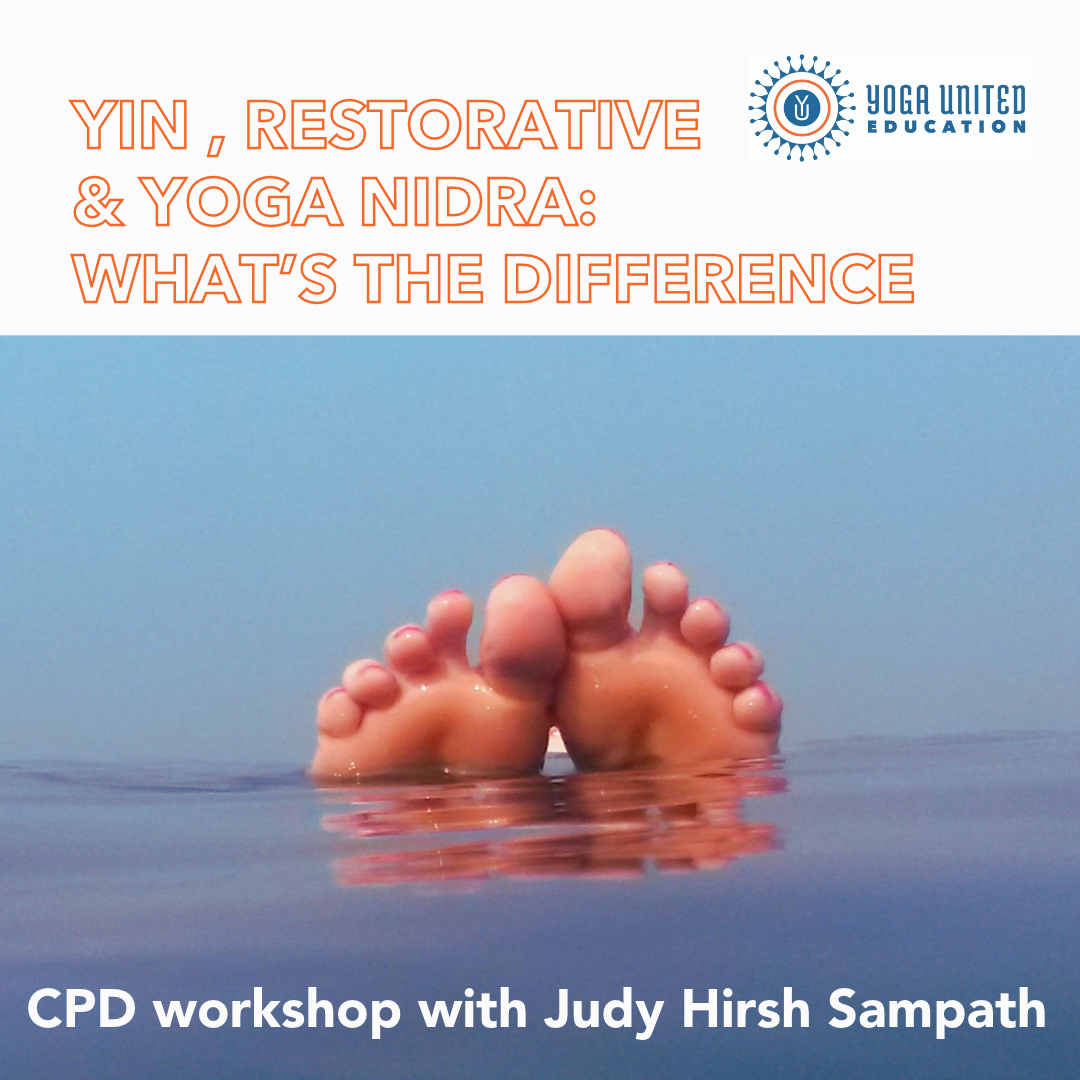
Yin Yoga, Restorative Yoga and Yoga Nidra are becoming increasingly popular. But what distinguishes them? How do you know which practice might meet your needs? And, as teachers, how can we respond to this growing demand?
Beyond coping: creating the conditions for ease
Yoga offers so much more than coping strategies and ways to manage symptoms. Movement, asana, breathwork, pranayama, mindfulness, attention on the present moment, and good-quality rest can support our capacity to regulate, recover and respond to life’s demands. Over time, these supportive practices may help us get more restful sleep, support us in making choices with greater clarity, feel more at ease in our bodies and find more peace in our minds. Slowing down can help us to recognise when we are pushing too hard, holding on unnecessarily or overlooking what we genuinely need. Active and passive stretching, yoga props like bolsters, zafus, eye pillows and blankets will be used to explore taking the support of the bones and muscles.
As teachers, we have a responsibility to be clear about the intention behind our choices. As we place less emphasis on perfecting a posture, we guide experiences that support balance, harmony and ease, a space where busy and disturbed humans can slow down, settle and re-set. Imagine students leaving class feeling softer around the edges, with a spring in their step and breathing a little easier. That is deeply fulfilling work for a teacher.
If, on the other hand, students leave feeling wired, depleted or even injured because they have pushed competitively or beyond their capacity, we may inadvertently be adding to the very sense of dis-ease they came to yoga to address.
Three different pathways to ease
The question is not simply what we teach, but how we teach it, why we choose it and whether it meets the needs of the people in front of us.
I’m excited to share our Continuing Professional Development course for yoga teachers and yoga students who like to be educated about what is going on in a class or workshop situation that may not be fully explained.
You can study online any time to exploree the differences between Yin Yoga, Restorative Yoga and Yoga Nidra, what is important about yoga props and how to use them. Recordings for the learning, the practices, and powerpoint presentations can be revisited any time.
We will look at the similarities and differences between these yoga offerings, why and how they work, and how to make informed choices about when it might be appropriate. We will also explore how to guide these practices with confidence, trauma sensitivity and a clear intention.
This student-centred approach means there is plenty of time to be close to the ground experiencing these practices for yourself so whether you are a yoga teacher looking to broaden your teaching repertoire or simply someone who would love a day away from the demands of ordinary life, come and let gravity do the work.
In summary:
- There is a growing awareness of mental health issues and the need for healthy coping strategies.
- Yoga offers more than ‘management’, creating lasting change by impacting the body’s systems at cellular level.
- Teachers focus on creating classes that promote balance, harmony, and ease, rather than pushing students into more tension.
- Teacher and student understanding of different techniques to settle the body, mind and nervous system.
- This CPD course – Understand the differences between yin, restorative, and yoga nidra with a focus on practice and experiential learning.
- Let’s work together to create classes and workshops that offer practices that meet people where they are and support their need for ease.
- Course facilitator: Judy Sampath, BWY CPD provider, yoga therapist, trainer, author and artist.
- To work with Judy – 1-2-1 yoga therapy, mentoring, supervision, classes or to host a workshop: [email protected]
- Buy the recorded course and get access now HERE
- the next Live in person training is for BWY Wales, May 2027 – book directly on the British Wheel of Yoga website
- Buy your props HERE
- To continue with Restorative Training in person in London and other recorded, live online short courses HERE
- To buy Judy’s book ‘From Form to Freedom: Transforming Yoga Teaching & Practice with Creative Play” HERE
